Ask anything: targeted questions before and after every Challenge



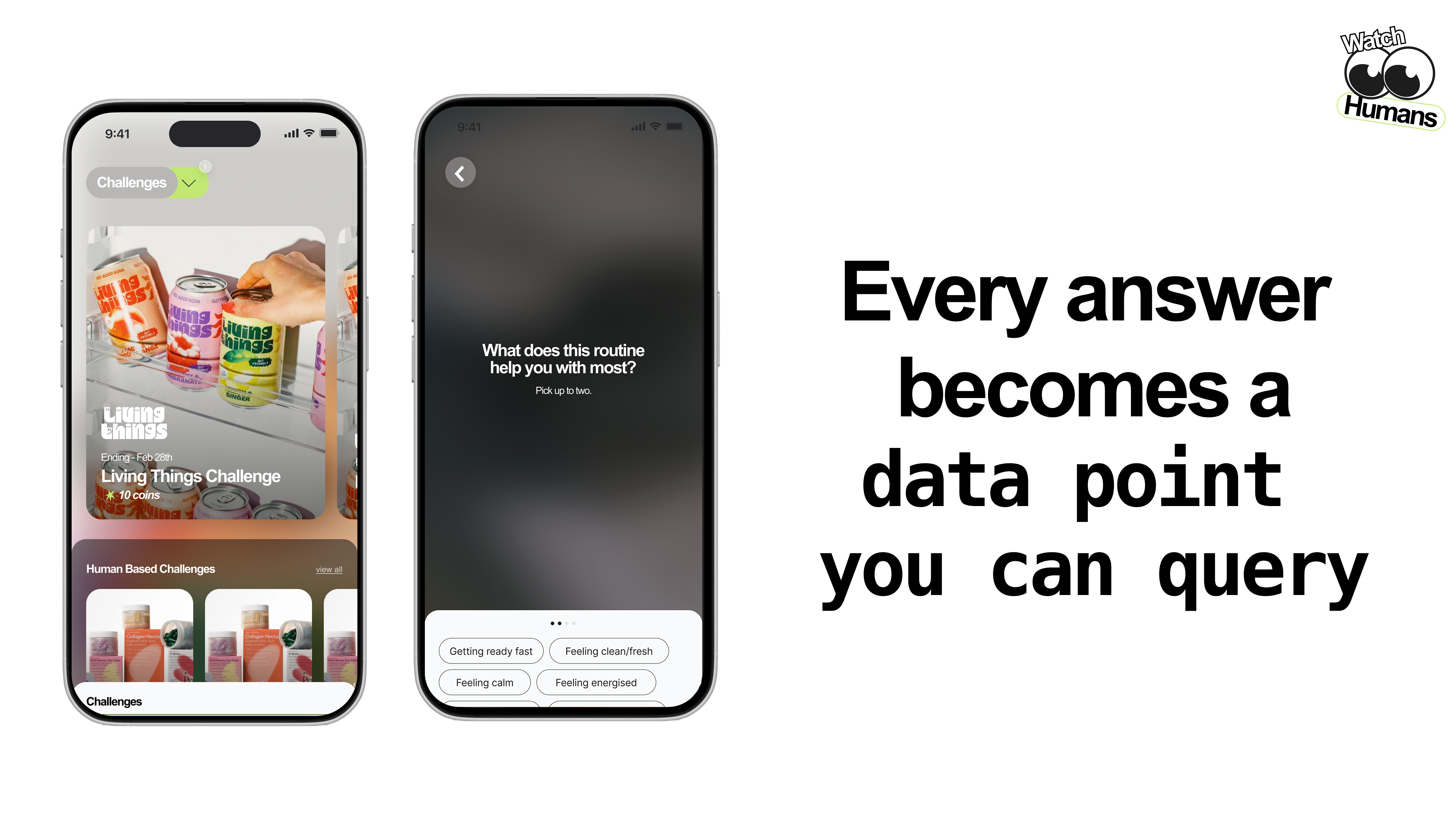
There is a reason brands dread research, and it is called the survey. Forty questions, a progress bar that barely moves, and a shopper who gives up halfway or clicks through just to be done. You end up with shallow, half-finished data about people who were bored before they started. We built Watch Humans to be the opposite of that, and this release closes one of the last gaps: the ability to ask your own specific questions, before and after a Challenge, without ever turning it back into a survey.
Quick refresher in case you are new here. A Challenge is a more structured brief we set a shopper inside the Watch Humans app: buy this, try this, or live with this for a week, and record an honest video review as you go. It is how we capture real behaviour in the moment that matters, rather than a self-reported memory of it weeks later. Everything below wraps around that Challenge to make each one work harder for you.
The problem: surveys are slow, and nobody finishes them
A traditional survey asks a shopper to sit still and self-report, in the abstract, away from the moment that actually matters. It is slow, it is dull, and the longer it gets the less honest it becomes. The irony is that the questions brands most want answered are good ones, they were just trapped inside a format people hate. So we kept the questions and threw away the survey.
Ask exactly what you want, before the Challenge
You can now attach your own pre-Challenge questions to any brief. These are the targeted, brand-specific things you have always wanted to know but never had a clean way to capture. Say you are running a Challenge on Living Things soda. The Challenge brief already gets you a rich, in-context video review, but you might also want to know exactly where this shopper sits in the category before they even taste it.
- What is their relationship with kombucha and pre and probiotic sodas?
- Which other sodas have they tried, and what did they switch from?
- When would they actually reach for this: after dinner, post-workout, mid-afternoon slump?
Some of this you can build straight into the brief, asking shoppers to review the product across different contexts, after dinner, post-workout, on a Friday night, so behaviour shows up naturally on camera. And some of it you simply want as a clean, static data point you can filter on later. Now you can do both: set the scene in the brief, and ask the precise questions alongside it. Every answer lands as a structured field you can query exactly the way you already query your reviews, so you can pull up every shopper who switched from kombucha, or everyone who would only reach for it post-workout, in a couple of clicks.
And ask how it landed, after the Challenge
Post-Challenge quizzes let you close the loop. Once a shopper has actually lived with a product, tested it for a week, worked it into their routine, you can ask what they really thought. Did it deliver on the promise? Did they feel any different? Would they buy it again, and what would stop them? This is the difference between a first impression and a considered verdict, and it is gold for understanding repeat behaviour.
This sharpens your Challenges, it does not replace them
To be clear, the Challenge brief is still the heart of it. The in-context video review is where the richest, most honest signal comes from, and nothing here changes that. Pre and post-Challenge questions are there to complement it: to pin down the specific data points a video alone will not always surface, and to let you tailor each study to the exact decision you are trying to make. The questions add precision around the story the video already tells.
A single video review, with your own questions wrapped around it, tells you more than a forty-question survey ever could, and the shopper actually enjoys giving it.
Why it matters: a holistic view that lifts ROAS
Here is what this really unlocks. When you layer your own targeted questions on top of a video review, you stop collecting fragments and start building a holistic picture of each shopper: who they are, what they buy around you, the occasions they shop for, and how they felt after living with your product. That depth is exactly what feeds smarter targeting, sharper messaging and, ultimately, better return on ad spend. You are no longer guessing which angle or audience to back, the shopper has told you.
Add your first pre or post-Challenge questions to your next brief and see how much more a single review can carry. As always, tell us what you want next; we read every reply.