Most commercial calls in retail are made on one kind of evidence. A range review runs on sales history. A listing decision runs on the buyer's read of the pitch. A marketing plan runs on last campaign's numbers. Each of these is a partial view being asked to carry a whole decision, and the gaps between them are where the expensive mistakes live.
Breakthrough is built on the opposite principle: a commercial call should be modelled from every signal that shapes it. That is what the seven dimensions are.
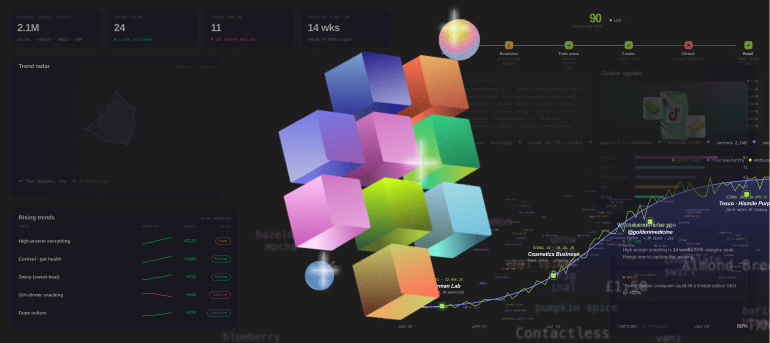
Six of them are intelligence inputs. Product Graph and Retail Intelligence maps the products themselves, 4M+ of them across 56,000+ attributes, so the system understands what is actually on shelf and how it relates. Brand and Performance Signals track how brands are trading and travelling. Culture and Trend Signals read the movements upstream of the category, before they reach the shelf. Market and Macro Signals account for the pressures no category escapes, from pricing to household spend. Watch Humans brings a direct source of behavioural intelligence from shoppers. Biometric Intelligence adds the biological layer of response that shoppers cannot articulate.
The seventh is different in kind. Synthetic is the simulation layer built on top of the other six. It takes everything the intelligence dimensions know and models the scenario in question: the range extension, the delist, the new listing, the price move. The results feed back into the Product Graph, so every simulation makes the next one sharper.
The point of the architecture is not the number. It is that the dimensions converge on a single decision. A category strategy built this way does not ask one dataset to answer questions it cannot see, and it does not leave the gaps between datasets to instinct. The evidence arrives already assembled around the call being made, which is the only place it was ever useful.